
All appearances are originally pure. Everything that arises is the display of awareness, inseparable from emptiness, complete just as it is.
If you practice Dzogchen or Buddhist tantra, you are familiar with this view. You have heard it many times. You’ve recited it in sadhanas. You may even feel aligned with it intellectually and devotionally.
But if we stay with that statement honestly, a question appears almost immediately.
If all appearances are already pure, what exactly are we trying to be liberated from?
If samsara is empty and inseparable from wisdom, on what basis do we talk about suffering at all?
And if nothing is wrong with appearances, what could buddhahood possibly mean?
These are not philosophical games. Most of us who practice the Dharma live with this tension quietly in the background of our lives.
We say that everything is pure by nature. And then, without noticing, we move through our days thinking things like:
This is samsara. This is just how karma works. This situation isn’t supportive of my practice. Once I figure out this problem, then my practice will flourish.
This all sounds realistic. Responsible. Mature. But notice what’s happening. Experience has been divided. Some moments are fit for practice. Others are explained away. Some appearances are quietly labeled as samsaric, ordinary, or not-conducive to the path.
We talk about non-duality, while still organizing our lives around fixing, managing, or getting away from the experience of our lives.
Work becomes the place where stress is inevitable and kindness is optional. Relationships become the place where our habitual patterns are understandable, justified, and therefore unworkable. We tell ourselves that this contradiction makes sense, given the circumstances. And in doing so, we place samsara firmly out there, in the world itself.
This is precisely the pressure point that Rongzom Chökyi Zangpo was willing to press:
If appearances are truly pure from the very beginning, then samsara cannot exist where we keep placing it. And if samsara is not established in appearances, then liberation must mean something far more intimate, and far more demanding, than escaping from the ordinary circumstances of our lives.
Rongzompa Raises the Stakes
Rongzom Mahāpandita was one of the earliest great scholar-practitioners of the Nyingma tradition. Writing in the eleventh century, he lived at a time when Buddhist philosophy in Tibet was becoming increasingly systematized, scholastic, and debate-oriented.
In particular, tantric Buddhism was being challenged from within the Buddhist community itself. Critics accepted emptiness, logic, and ethical discipline, but questioned whether tantric methods were coherent, necessary, or even compatible with the Madhyamaka view. This period saw the emergence and consolidation of what later came to be known as the Sarma, or New Schools, along with intensified philosophical scrutiny of tantric claims.
Rongzompa took these critiques seriously. And he answered them on their own ground.
His treatise Establishing Appearances as Divine takes up a question that many traditions avoid. If emptiness is the nature of phenomena, and if appearance and emptiness are inseparable like we say in Madhyamaka, then appearances cannot be intrinsically impure. If they were, emptiness would no longer be their nature. Purity would have to be imposed from somewhere else, liberation would become a corrective project, and the inseparability of appearance and emptiness would collapse from the start. Rongzom refuses this entirely.
For Rongzom, this is the real issue at stake. Not whether tantric practice is powerful or inspiring, but whether it is ontologically and epistemically coherent.
For him, appearances are not raw material waiting to be purified by realization of the ultimate. They are already the display of emptiness. Any path that treats appearances as fundamentally flawed misunderstands emptiness from the very beginning.
This is why Rongzom’s argument matters far more than philosophical debate. He is not merely defending a method. He is clarifying where samsara can and cannot be established. And in doing so, he lays down a view that later Dzogchen masters would clarify experientially, but that he articulated first with philosophical precision.
This claim was bold, and it was risky at the time. If misunderstood, it collapses into indifference or nihilism. Rongzom’s task was to carefully show why neither follows.
If Appearances Are Pure, What Is Samsara?
The first clarification is simple, but decisive.
Samsara is not established at the level of appearances.
Appearances arise continuously. Sights, sounds, thoughts, emotions, sensations. They come and go without obstruction. Nothing about their arising is a problem. Nothing about their texture is impure.
Samsara begins somewhere else.
Samsara is established at the level of misrecognition.
When the nature of appearances in all their variety are not known as empty and luminous, they bind us. When their empty nature is not recognized, appearance becomes something real that we grasp, resist, fear, or cling to. In other words, samsara is not a world we inhabit. It is a way we experience the world of appearance and possibility.
This is a crucial shift. Samsara is not “out there,” waiting to be deconstructed by the ascetic renunciate or liberated by the courageous bodhisattva. It is a mode of presence we continue to sustain. The same appearance that liberates when recognized becomes the basis of confusion when it is not.
Nothing has changed in appearance. Only how we meet that experience.
Then Why Does Suffering Feel So Real?
At this point, a reasonable objection arises.
If samsara has no ultimate footing, why does suffering matter so much? Are we just telling ourselves that pain is an illusion?
Rongzom’s answer is clear. Suffering is experienced, even though it is empty of essence.
Pain hurts. Fear constricts our mind. Habitual patterns repeat themselves. Karma continues to work its uncompromising ledger. None of this is denied. What is denied is that suffering requires an impure reality to explain it.
Let’s say this with a very familiar metaphor. The problem is not the rope. The problem is mistaking it for a snake. We experience the fear, the panic. The body responds. But the solution is not to destroy the rope. It is to see it clearly for what it is.
This avoids the two extremes of exaggeration or denial that practitioners often fall into.
It avoids nihilism, because suffering is not brushed aside as “nothing.” And it avoids eternalism, because suffering does not require a flawed world that must be fixed before we can find freedom.
If All Appearances Are Equal, What Is Liberation?
Now we come to the heart of the matter.
If appearances are already pure and equal in nature, liberation cannot be about changing appearances. It cannot be about reaching a better version of reality. And it cannot be about escaping this world for another one.
Liberation is a change in how we stand within experience, not a change in experience itself.
As long as we stand somewhere in relation to what arises, preferring this and rejecting that, hoping for one outcome and fearing another, samsara continues. Even spiritual positions can quietly keep this machinery of samsara running. Sacred art versus pictures of your family. Meditation versus daily life. Freedom versus suffering.
The division itself is the problem.
Liberation, from this view, is the exhaustion of that division. It is the collapse of the interpreter who needs experience to be something else in order to be at ease.
This is not indifference. It is intimacy with the nature of reality as it is without grasping.
Then Why Compassion? Why End Suffering?
At this point, another concern appears.
If nothing is wrong with appearances, why bother with compassion? Why are we trying to end suffering at all? Why do we take bodhisattva vows?
Because suffering is what confusion feels like from the inside.
Compassion does not arise because reality is broken (though it seems to be). It arises because beings are confused about the nature of that reality. When recognition is absent, our experience binds us and we are trapped in that suffering. Compassion responds to that bondage, not by fixing the outer course of things, but by helping loosen the misunderstanding that is the root of suffering.
Nothing contradicts purity here. Compassion naturally flows from the view.
We do not help others because the world is impure. We help because confusion is painful and clarity is possible.
What This Changes in Our Practice
When this view is taken seriously, it changes our practice completely.
Practice is no longer about purifying appearances. It is no longer about escaping the outer world of samsara. And it is no longer about constructing a so-called “better state” to live in.
Practice becomes a commitment to presence, to not turning away.
It becomes a fierce determination to remain present in all situations as they are. To stay open when the heart wants to shut down. To remain available when habits pull at us to withdraw, defend, or explain ourselves.
From this perspective, practice is learning how not to fall back into ordinary misrecognition. Learning how to let appearances liberate themselves rather than bind us. Learning how to remain present without dividing experience into what should and should not be happening.
This is where teachings on rigpa, buddhanature, tantra, Mahamudra, and Dzogchen stop being abstract. They stop pointing toward a distant realization and begin pointing directly into lived experience.
How do we meet a difficult conversation? How do we stay with fear without becoming rigid? How do we allow joy without grasping? How do we remain open when the mind feels restless, dull, or sensitive?
Nothing needs to be improved for liberation to be possible. But the view does need to be recognized.
And that recognition does not happen apart from life. It happens in the middle of it.
The Question We Are Left With
Rongzompa leaves us with a quiet but demanding challenge.
Can we remain fully present in a world where nothing is wrong, without withdrawing or becoming indifferent?
Can we take suffering seriously, meeting it as real and painful, without turning it into something solid and fixed?
And can liberation be lived as presence, rather than escape?
These questions do not ask us to adopt a new belief. They ask us to check our posture. To look more carefully at what is already here, and at how we relate to it, moment by moment.
In that sense, the view that all appearances are pure is not always comforting. It is clarifying though. It removes our usual exit strategies. And it places responsibility exactly where Rongzompa insists it belongs.
Not on fixing the world. Not on escaping our lives. But on recognizing what has always been present, and learning how to remain open to it.
That recognition, sustained with care and courage, is what allows freedom, love, compassion, and equanimity to appear. Not in some far-off pure land, but in the midst of ordinary life, exactly as it is.
How We Carry This View into Meditation
With this understanding of Rongzompa’s view that all appearances are originally pure, then meditation cannot be about producing a better experience. It cannot be about replacing what is arising with something more refined. And it cannot be about waiting for the mind to settle down and cooperate before practice begins.
From Rongzompa’s perspective, meditation is where this view is either embodied or quietly abandoned.
Dzogchen: Resting Without Editing Experience
In Dzogchen, resting in the uncontrived natural state is not a conceptual designation that we hold in mind. It is not repeating the thought, “Everything is pure.” It is the direct recognition of the naturally occurring display of awareness being free in its own place.
Thoughts arise. Sensations arise. Emotions arise. Sounds, images, memories, and moods all appear and dissolve. Nothing is filtered out. Nothing is fabricated or corrected.
Purity here does not mean calm or clarity. It does not mean the absence of thought. It means that whatever arises is recognized as the display of awareness, inseparable from emptiness, without needing to be altered or fixed.
The moment we think, “I need to stop thinking so much,” or “I’m stuck in dullness,” we have already stepped out of recognition and into management. Not because something went wrong, but because we quietly decided that this appearance does not belong.
Carrying this view into meditation means learning not to take a position toward what arises. Not following. Not suppressing. Not improving. Just rest. Let it be as it is. It is the willingness to remain present; alert, open, and responsive.
Tantra: Recognizing Purity Rather Than Producing It
In tantric practice, this view expresses itself slightly differently, but the ground is the same.
Tantra is often taught as a method of purifying impure appearances into pure appearances. From Rongzom’s standpoint, this language is provisional. The deeper point is not transformation, but recognition.
Sights, sounds, and thoughts are not made divine. They are experienced as what they already are: the play of enlightened body, speech, and mind.
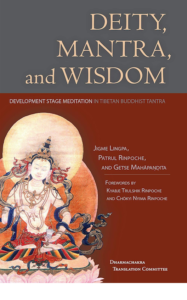
Deity, Mantra, and Wisdom explore this experience more deeply
Deity yoga trains perception not to collapse form into ordinary body. Mantra trains sound not to be reduced to ordinary speech. Wisdom mind is not produced by rejecting thoughts, but revealed when thought is no longer misrecognized.
When this view is carried into tantric conduct, practice is no longer about acceptance or rejection. It is about remaining present with whatever arises, without slipping back into ordinary perception.
In that sense, practice is not a retreat from life. It is practice for presence. Staying open. Staying responsive.
This is how Rongzom’s view becomes lived. Not as a belief about reality, but as a way of being, moment by moment, without turning away from what is already here.
Carrying the View into Conduct
To see how this view lives in the world, we do not need an extraordinary example. We can take a walk.
We step outside. The trees are blowing in the wind. Birds chirp. A car passes by. A neighbor walks by and says hello. The body moves, your feet meeting the ground, the air on your skin.
Nothing special is happening. And that is precisely the point.
If we are carrying the view into conduct, we are not moving through samsara. There is no samsara out there to walk through. There is no impure world waiting to be transcended. There is simply experience unfolding.
Sights. Sounds. Movement. Contact. All of it appears within awareness, inseparable from emptiness, vivid and responsive.
We are present, not because we are concentrating, but because we are not resisting what is coming up. We respond naturally to what appears. We step aside for the car. We return the greeting. We feel the warmth of the sun or the bite of the cold. None of this needs to be reinterpreted as practice. It already is.
From Rongzom’s view, this is not a provisional freedom. It is not a taste of liberation that points somewhere else. Freedom is not postponed until conditions improve. It is not deferred to a future realization or a purer realm.
Freedom is this openness itself. This is the yoga of spontaneous presence: great, baseless equanimity.
Conduct, in this sense, is not about behaving in a special way. It is about not collapsing experience into ordinariness. Not dulling it. Not bracing against it. Not stepping outside it to overcome it.
Everything we encounter is the infinite play of dependent origination. Nothing stands alone. Nothing has a fixed center. Each appearance arises in dependence, unfolds, and dissolves, empty and luminous at once.
This does not make us passive observers in the world. It makes us responsive. When a response is needed, response happens. When speech is appropriate, speech arises. When silence is appropriate, silence remains. Action is not driven by contraction or avoidance, but by presence and clarity.
From the outside, this can look very ordinary. A person walking. A greeting exchanged. A life being lived.
From the inside, there is no sense of moving toward liberation or away from samsara. There is simply the refusal to withdraw from what is happening.
This is what it means to carry the view into conduct. Free as we are, in the world as it is.